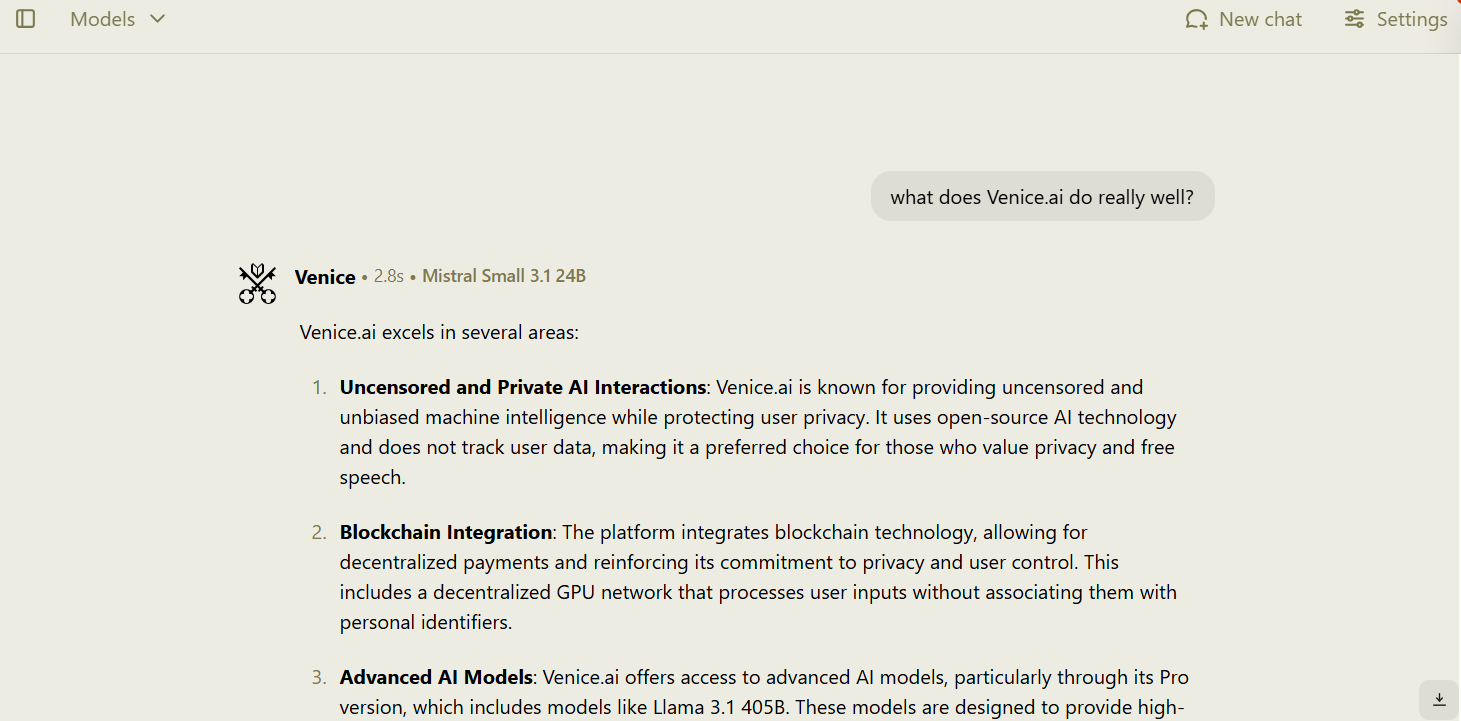
Venice.ai is a cutting-edge AI platform designed to provide private, uncensored, and unrestricted intelligence. Built on open-source technologies, Venice.ai empowers users with advanced tools for text, image, and code generation, all while prioritizing privacy and decentralization.
What makes Venice AI different?
Venice.ai is a versatile AI platform that excels in several key areas, offering advanced tools for text, image, and code generation. Here’s a breakdown of its capabilities and strengths:
1. **Text Generation**: Venice.ai uses open-source models like Meta’s Llama 3 to deliver high-quality text-based outputs. It can assist with tasks such as creative writing, answering questions, and generating ideas, making it a valuable tool for writers, researchers, and professionals.
2. **Image Generation**: Powered by models like Stable Diffusion, Venice.ai produces high-resolution, visually stunning images. Its flexibility allows users to create detailed visual art based on prompts, catering to designers, marketers, and artists.
3. **Code Generation**: Developers can leverage Venice.ai to generate code snippets, debug algorithms, or brainstorm programming solutions. Its privacy-focused design ensures that proprietary code remains secure.
4. **Privacy and Decentralization**: One of Venice.ai’s standout features is its commitment to user privacy. Unlike many platforms, it doesn’t store user conversations on external servers. Instead, data remains securely on the user’s device, offering a private and anonymous experience.
5. **Customizability**: Pro users can disable safety filters and modify system prompts, allowing for a more personalized and unrestricted interaction with the AI. This makes Venice.ai particularly appealing to users seeking creative freedom.
6. **Uncensored Exploration**: Venice.ai allows users to engage in open-ended inquiries without heavy content restrictions, fostering a judgment-free environment for exploration and innovation.
These capabilities make Venice.ai a powerful tool for a wide range of applications, from creative projects to technical problem-solving. Its emphasis on privacy and decentralization sets it apart, ensuring users can interact with AI securely and without limitations.
Venice AI Privacy Features
Data Handling:
- Does not store or access user prompts or chat history; data remains on the user’s device.
User Controls:
- No account required; users can access the platform anonymously.
- Chat history is stored locally and can be deleted by the user.
Privacy Considerations:
- Designed with a privacy-first approach, minimizing data collection and storage.
Privacy Comparison vs. Other AI Web Tools
| Feature | ChatGPT | Microsoft Copilot | Google Gemini | Venice AI |
|---|---|---|---|---|
| Data Used for Training | Yes (unless disabled) | No (for enterprise users) | Yes (some data) | No |
| Local Data Storage | No | Yes (Recall feature) | No | Yes |
| Human Review of Data | Possible | No | Yes | No |
| User Control over Data | Yes | Yes | Yes | Yes |
| Account Requirement | Yes | Yes | Yes | No |
Image Generation
The following open-source AI models are available on Venice for image generation:
- Join
- LLaMA 3
- Playground 2.5
These models allow users to generate a variety of images in over 70 styles, making it possible to create art, photos, and more. The image generation feature is designed to be user-friendly, enabling quick and easy creation of unique visuals.

Venice AI and Blockchain Technology
Venice.ai integrates blockchain technology to enhance privacy, security, and decentralization in its operations. Here’s how the blockchain integration works:
1. **Decentralized Payments**: Venice.ai uses blockchain for decentralized payments, allowing users to transact without the need for intermediaries. This ensures that payments are secure, transparent, and efficient. Users can pay for services using the Venice Token (VVV), which operates on the Base blockchain.
2. **Privacy and Security**: Blockchain technology provides a high level of security and privacy. Transactions and interactions on Venice.ai are recorded on a decentralized ledger, making it difficult for any single entity to control or manipulate the data. This ensures that user interactions remain private and secure.
3. **Decentralized GPU Network**: Venice.ai operates a decentralized GPU network that processes user inputs. This network is composed of multiple nodes that work together to handle computations without associating them with personal identifiers. This decentralized approach enhances privacy and prevents data monopolization.
4. **Venice Token (VVV)**: The Venice Token (VVV) is the native cryptocurrency of the Venice.ai platform. It exists on the Base blockchain and is used for various transactions within the ecosystem. The token has a starting supply of 100 million coins with an annual inflation of 14 million coins. Users can stake VVV to access the Venice API for inference and earn a staking yield.
5. **Transparency and Trust**: Blockchain integration ensures transparency in operations. All transactions and interactions are recorded on a public ledger, which can be audited by anyone. This transparency builds trust among users and ensures that the platform operates fairly and openly.
6. **User Control**: By using blockchain technology, Venice.ai gives users more control over their data and interactions. Users can manage their own keys and transactions, reducing the risk of data breaches and unauthorized access.
7. **Smart Contracts**: Venice.ai likely uses smart contracts to automate various processes on the platform. Smart contracts are self-executing contracts with the terms of the agreement directly written into lines of code. They automate the execution of an agreement as soon as predefined conditions are met, ensuring that transactions are carried out efficiently and without the need for intermediaries.
8. **Interoperability**: Blockchain technology allows for interoperability with other blockchain-based systems and services. This means that Venice.ai can potentially integrate with other decentralized applications (dApps) and services, expanding its functionality and reach.
In summary, blockchain integration in Venice.ai enhances privacy, security, and decentralization, providing users with a secure and transparent platform for interacting with AI. The use of the Venice Token (VVV) and decentralized GPU network further strengthens these principles, making Venice.ai a unique and innovative player in the AI landscape.